Though now retired, this blog once served as a more informal means for our reporters, editor and webmaster to share items of interest with our readership.
There have been no new posts in years, but you are free to browse through the archives and read older posts.
The links to the right side will help you browse by year and blog post.
Enjoy!
Wednesday, June 15, 2011


Thursday, May 24, 2007
Our Last Post
This, the 159th post on this blog, will be our last. After an editorial meeting and brief discussion, the staff of the newspaper, and myself in particular, have chosen to close down this blog.
That's not to rule out a resurrection in the future -- it would certainly be a theme not foreign to Christianity -- but we simply have found that the time and sacrifice of running this blog is not worth the small amount of traffic it receives. We are and have been grateful to the number of you who faithfully checked in with us, but it was simply not enough (especially compared to the traffic at www.CriterionOnline.com) to justify continuing.
It is also true that in the past few months the number of posts has waned dramatically as I became busy with several other projects and The Criterion staff with their upcoming redesign and usual barrage of stories.
This blog was in part an attempt toward staying up with the latest trends in communications -- trends which change with a suspiciously un-rooted regularity -- and as it did not help us to make great strides in communications, we will focus our evangelical efforts elsewhere (striving to make both The Criterion and the archdiocesan website better).
So again, thank you, faithful readers, and we'll continue to see you in the print and Web versions of the largest weekly newspaper in the State of Indiana.
(This blog account will stay active for archival purposes.)
That's not to rule out a resurrection in the future -- it would certainly be a theme not foreign to Christianity -- but we simply have found that the time and sacrifice of running this blog is not worth the small amount of traffic it receives. We are and have been grateful to the number of you who faithfully checked in with us, but it was simply not enough (especially compared to the traffic at www.CriterionOnline.com) to justify continuing.
It is also true that in the past few months the number of posts has waned dramatically as I became busy with several other projects and The Criterion staff with their upcoming redesign and usual barrage of stories.
This blog was in part an attempt toward staying up with the latest trends in communications -- trends which change with a suspiciously un-rooted regularity -- and as it did not help us to make great strides in communications, we will focus our evangelical efforts elsewhere (striving to make both The Criterion and the archdiocesan website better).
So again, thank you, faithful readers, and we'll continue to see you in the print and Web versions of the largest weekly newspaper in the State of Indiana.
(This blog account will stay active for archival purposes.)
Monday, April 16, 2007
Happy Birthday, Pope Benedict!
A story posted by Catholic News Service about the 80th birthday of the pontiff:
Pope, turning 80, thanks church for surrounding him with affection
Also:
Pope Benedict at 80: Blowing on the coals of faith
Pope, turning 80, thanks church for surrounding him with affection
Also:
Pope Benedict at 80: Blowing on the coals of faith
Wednesday, March 07, 2007
You know what really grinds my gears?
For those of you that get the "Family Guy" reference above, shame on you for watching such a blasphemous show. For those that don't get the reference...consider this an annoyance post.
You know what really grinds my gears?
- Charities that send me a request for donations that include a nickel. Why would you send me a nickel? What in the world am I going to do with a nickel? It must cost a small fortune to throw a nickel into every envelope you send out, but it means nothing to me. DON'T SEND ME A NICKEL. Send a dollar, then we'll talk. Also, don't send me any more pennies with crosses punched into them or coins with angels on them. (I've started collecting the angel coins to see how many I can get -- my collection of about a dozen drives my wife nuts.)
- "UNRATED!" versions of movies. I mean, come on. It's bad enough that PG-13 movies will sneak every possible bit of sexuality, violence and language in that they can. But have you noticed how many of these movies make it to DVD in an "unrated" format? And in most cases you can't get any other version. I've heard that for several movies this merely means putting back in countless "F-word" usages or topless scenes or the like. As a habit, if a movie boasts that its DVD version is "UNRATED!" it usually gets "UNRENTED!" by me. (Note also that any movie that is unrated gets around that little label that usually appears on movies that explains the rating...parents have no idea what they're getting.)
- Technology driven by money. You know, I've got a cell phone from the Archdiocese of Indianapolis -- you've probably heard of the thing by now: the RAZR. Oh, it's very slim and all that, and it has a really cool program to keep track of the weather, but that's about it. The thing runs slowly and hardly lets you customize anything. Why does it run slowly? Because it is absolutely jam-packed with all sorts of features that you can activate for money. Download videos (for money)! Get online (for money)! Send pics (for money)! Get ringtones (for money)! Watch the news (for money)! And why can't anything be customized? Because they want you to see an ad every time you turn it on or off, and because all but one of the shortcut keys doesn't take you to a function you actually use but something that they want you to use (that costs, of course, money). The use of the phone is impaired by the fact that it seems designed not primarily to be a cell phone, but primarily to be a means to get you to buy other things. It's a battery-powered, flip-style, grey-colored commercial.
- Now that I think of it, acronyms are really starting to grind my gears. Want a cell phone? Get a RAZR or a KRZR or a ROKR! Even the Catholic world is not immune: our Office of Catholic Education has EXCEED and CSW and TAP and SPRED and so on. What's wrong with acronyms? Technically: nothing. Where are they forbidden in the Catechism? Technically: no where. All I'm saying is that enough is enough and that they really GMG.
- Presidential elections that start years before the polls open. That so much time is dedicated to a primary a year from happening sure does grind my gears. I have yet to hear any coherent explanation as to why I should care who is leading the polls at the moment. Each vote is important, but not so important that it takes two years to think about. I guess some people have sports, some politics. In that case, call me next spring on this one. But, but, but! Didn't you hear that Clinton and Giuliani are...hey! No! Not listening; don't care, don't care, don't care.
- You know what really grinds my gears? People that disagree with me about anything. It's just not right. It's a TON of work trying to reason with all of you.
And that, ahem, is what really grinds my gears.
You know what really grinds my gears?
- Charities that send me a request for donations that include a nickel. Why would you send me a nickel? What in the world am I going to do with a nickel? It must cost a small fortune to throw a nickel into every envelope you send out, but it means nothing to me. DON'T SEND ME A NICKEL. Send a dollar, then we'll talk. Also, don't send me any more pennies with crosses punched into them or coins with angels on them. (I've started collecting the angel coins to see how many I can get -- my collection of about a dozen drives my wife nuts.)
- "UNRATED!" versions of movies. I mean, come on. It's bad enough that PG-13 movies will sneak every possible bit of sexuality, violence and language in that they can. But have you noticed how many of these movies make it to DVD in an "unrated" format? And in most cases you can't get any other version. I've heard that for several movies this merely means putting back in countless "F-word" usages or topless scenes or the like. As a habit, if a movie boasts that its DVD version is "UNRATED!" it usually gets "UNRENTED!" by me. (Note also that any movie that is unrated gets around that little label that usually appears on movies that explains the rating...parents have no idea what they're getting.)
- Technology driven by money. You know, I've got a cell phone from the Archdiocese of Indianapolis -- you've probably heard of the thing by now: the RAZR. Oh, it's very slim and all that, and it has a really cool program to keep track of the weather, but that's about it. The thing runs slowly and hardly lets you customize anything. Why does it run slowly? Because it is absolutely jam-packed with all sorts of features that you can activate for money. Download videos (for money)! Get online (for money)! Send pics (for money)! Get ringtones (for money)! Watch the news (for money)! And why can't anything be customized? Because they want you to see an ad every time you turn it on or off, and because all but one of the shortcut keys doesn't take you to a function you actually use but something that they want you to use (that costs, of course, money). The use of the phone is impaired by the fact that it seems designed not primarily to be a cell phone, but primarily to be a means to get you to buy other things. It's a battery-powered, flip-style, grey-colored commercial.
- Now that I think of it, acronyms are really starting to grind my gears. Want a cell phone? Get a RAZR or a KRZR or a ROKR! Even the Catholic world is not immune: our Office of Catholic Education has EXCEED and CSW and TAP and SPRED and so on. What's wrong with acronyms? Technically: nothing. Where are they forbidden in the Catechism? Technically: no where. All I'm saying is that enough is enough and that they really GMG.
- Presidential elections that start years before the polls open. That so much time is dedicated to a primary a year from happening sure does grind my gears. I have yet to hear any coherent explanation as to why I should care who is leading the polls at the moment. Each vote is important, but not so important that it takes two years to think about. I guess some people have sports, some politics. In that case, call me next spring on this one. But, but, but! Didn't you hear that Clinton and Giuliani are...hey! No! Not listening; don't care, don't care, don't care.
- You know what really grinds my gears? People that disagree with me about anything. It's just not right. It's a TON of work trying to reason with all of you.
And that, ahem, is what really grinds my gears.
Supporting the Troops (Just War Style)
I was flipping around on the TV last night and came across one of the Christian channels. The talk show on at the moment was featuring an interview with Sen. John McCain, so my wife and I tuned in for a few moments.
One of the things that he and the interviewer (and the audience, apparently) were in agreement about was that neither could understand how you could call the cause of the war in Iraq unjust and still support the troops. This immediately made me wonder: is he saying that even if the war were unjust that we could not say so? Or that an unjust war is not possible given our duty to support the troops?
It must have strongly to do with the time that I was born, but I imagine that many in my generation have a different emphasis when it comes to "supporting the troops." Men and women who are willing to go to war -- to fight and to die -- for this country have a special place in my thoughts and my heart. They are, quite literally, heroes. The same goes for firefighters and all others go above and beyond to do the things that must be done in the defense of life and liberty. But for many people, the duty to support the troops goes beyond this -- it is almost a bit of divine law; a piece of the cultural code that cannot, for any reason, be broken or even seem to be broken.
It is obvious that any President is fallible, and obvious that not all wars are just. So then, if we find ourselves in an unjust war, should we not speak out against it? Can we not call real what is real? Or is our only role to support the troops and vote "the other way" next election?
To say that you honor and support our troops for the sacrifice they make is valid. To say that a war is unjust is also valid. Both can be statements of fact. I suspect that it is more the fickle, divisive, doomsday-predicting nature of pop-protesters that is more at the root of this problem -- people who, in reality, don't like the President and don't need much to ignore his orders. What McCain and others are most frustrating about (WARNING: this is just a guess -- I can't read hearts) is the individualistic tendency of Americans to all want to be little presidents and little popes -- everyone wants to decide what's right and wrong and we want everyone to know. That's why we all have blogs. Like this one. (Ignore my own hypocrisy)
What we need from more protesters is the clear restatement that a President's orders matter and should, in most every case, be followed (or at least tolerated). Sean Gallagher (a reporter for The Criterion and poster on this blog) reminds me as well that oftentimes we don't know all that goes into a President's decision until some time after the fact.
While troops must follow God first, it is the President who orders the use of force and who answers to God for it. It is a soldiers duty to follow orders unless those orders clearly and grossly violate the duty to faithful serve God and neighbor. Therefore, our troops are in Iraq doing their duty while protesters back home do there's by calling the President to reconsider his strategy.
Support the troops? Absolutely. Question the war? Sure -- but it should be done carefully, cautiously, and with every measure of intelligent, civil discourse possible.
One of the things that he and the interviewer (and the audience, apparently) were in agreement about was that neither could understand how you could call the cause of the war in Iraq unjust and still support the troops. This immediately made me wonder: is he saying that even if the war were unjust that we could not say so? Or that an unjust war is not possible given our duty to support the troops?
It must have strongly to do with the time that I was born, but I imagine that many in my generation have a different emphasis when it comes to "supporting the troops." Men and women who are willing to go to war -- to fight and to die -- for this country have a special place in my thoughts and my heart. They are, quite literally, heroes. The same goes for firefighters and all others go above and beyond to do the things that must be done in the defense of life and liberty. But for many people, the duty to support the troops goes beyond this -- it is almost a bit of divine law; a piece of the cultural code that cannot, for any reason, be broken or even seem to be broken.
It is obvious that any President is fallible, and obvious that not all wars are just. So then, if we find ourselves in an unjust war, should we not speak out against it? Can we not call real what is real? Or is our only role to support the troops and vote "the other way" next election?
To say that you honor and support our troops for the sacrifice they make is valid. To say that a war is unjust is also valid. Both can be statements of fact. I suspect that it is more the fickle, divisive, doomsday-predicting nature of pop-protesters that is more at the root of this problem -- people who, in reality, don't like the President and don't need much to ignore his orders. What McCain and others are most frustrating about (WARNING: this is just a guess -- I can't read hearts) is the individualistic tendency of Americans to all want to be little presidents and little popes -- everyone wants to decide what's right and wrong and we want everyone to know. That's why we all have blogs. Like this one. (Ignore my own hypocrisy)
What we need from more protesters is the clear restatement that a President's orders matter and should, in most every case, be followed (or at least tolerated). Sean Gallagher (a reporter for The Criterion and poster on this blog) reminds me as well that oftentimes we don't know all that goes into a President's decision until some time after the fact.
While troops must follow God first, it is the President who orders the use of force and who answers to God for it. It is a soldiers duty to follow orders unless those orders clearly and grossly violate the duty to faithful serve God and neighbor. Therefore, our troops are in Iraq doing their duty while protesters back home do there's by calling the President to reconsider his strategy.
Support the troops? Absolutely. Question the war? Sure -- but it should be done carefully, cautiously, and with every measure of intelligent, civil discourse possible.
Monday, March 05, 2007
The power of the blog and all that
As you can tell by the updates on the post below ("Your own little piece of holiness"), the story regarding the "relics" of the late pope has changed -- and I thought it deserved it's own post again.
Catholic News Service has posted this new story:
Catholic News Service has posted this new story:
You can learn more, apparently, by logging on to www.JohnPaulIIBeatification.org, or by mailing the office at: Postulazione Giovanni Paolo II, Vicariato di Roma, Piazza San Giovanni in Laterano 6A, 00184 Rome, ItalyROME (CNS) -- The Rome diocesan office charged with promoting the sainthood cause of Pope John Paul II has exceeded its postage budget because of increased requests for prayer cards and relics of the late pope.
"We were getting about 50 requests a day, but overnight it grew to between 500 and 1,000 requests," a spokeswoman for the office said March 2.
"We could not have foreseen this demand," she said. "It's an avalanche."
Franciscan Brother Chris Gaffrey, who assists the office with English translations, told Catholic News Service that the vast majority of requests in late February and early March were coming via e-mail from the United States.
CNS had published a story about the cards and relics Feb. 26 and dozens of Web sites and blogs, or Web logs, ran links to the story.
The prayer cards and relics, a small piece of one of the white cassocks worn by Pope John Paul, always will be distributed free of charge, but without an increase in donations the office cannot afford to mail them, Brother Gaffrey said.
- - - - - - -
An individual prayer card, relic and copy of the cause's magazine, Totus Tuus, could be mailed to the United States for about $5, Brother Gaffrey said.
Monday, February 26, 2007
Your own little piece of holiness
Just saw this item on the client-area (no public link) on CNS: "Rome office issues prayer cards, relics to promote sainthood for JPII"
"Wow," I thought. "Who do you have to know to get a relic of John Paul?" Well, apparently you only have to know how to send an e-mail, fax or letter. That's right: Rome is giving them away. (actually, no longer free...see "second update" below)
Now, I had to clarify to a coworker that this isn't a "bone relic" but a "cloth relic." That is, it isn't a first class relic, but a second class relic (an item worn or used by the person in question, like a Rosary or a shirt.). In this case, Rome's diocesan office promoting the Cause of Canonization of the late pope is distributing a prayer card and a piece of one of the white cassocks worn by JPII.
These are the only authorized relics currently being distributed. So, do send for your prayer card and relic and let them help you do your part in praying for the sainthood cause of John Paul the Great!
Here's the pertinent info:
(SECOND UPDATE: Read the comment left on this post. The office in Rome responsible for sending out these cards has received a huge spike in requests, and because of postage costs can no longer send them out for free. For a donation, they will send the card and piece of cloth.)
"Wow," I thought. "Who do you have to know to get a relic of John Paul?" Well, apparently you only have to know how to send an e-mail, fax or letter. That's right: Rome is giving them away. (actually, no longer free...see "second update" below)
Now, I had to clarify to a coworker that this isn't a "bone relic" but a "cloth relic." That is, it isn't a first class relic, but a second class relic (an item worn or used by the person in question, like a Rosary or a shirt.). In this case, Rome's diocesan office promoting the Cause of Canonization of the late pope is distributing a prayer card and a piece of one of the white cassocks worn by JPII.
These are the only authorized relics currently being distributed. So, do send for your prayer card and relic and let them help you do your part in praying for the sainthood cause of John Paul the Great!
Here's the pertinent info:
The e-mail address is: Postulazione.GiovanniPaoloII@VicariatusUrbis.org
The fax number is: (39-06) 6888-6240.
The mailing address is: Postulazione Giovanni Paolo II, Vicariato di Roma, Piazza San Giovanni in Laterano 6A, 00184 Rome, Italy.
(SECOND UPDATE: Read the comment left on this post. The office in Rome responsible for sending out these cards has received a huge spike in requests, and because of postage costs can no longer send them out for free. For a donation, they will send the card and piece of cloth.)
Monday, February 19, 2007
This Lent, instead of giving something up...
Not to get my rant on, but here's a homily/column/reflection topic that I'm getting rather tired of hearing:
"This Lent, instead of giving something up..."
You fill in the blank with any number of good things: "...try being a better person" or "...do something nice for someone" or some other such thing.
See, it was always my impression that you were already supposed to be doing those types of things -- especially in Lent -- in addition to fasting. It kind of falls under that fasting AND almsgiving type of thing. In the words of the old advertising campaign for Indiana University-Purdue University Indianapolis: "Why not both?"
Lent is a time that calls us to prayer, sacrifice and acts of charity. I have no doubt that many people find giving up sweets easier than helping their neighbor, and are quite content to do just the former. So I'm fine with homilies and columns that remind us of the orientation of sacrifice: to not only recall (and join) the suffering of the Lord during his time on Earth but also to teach us discipline. And when we grow more perfect in discipline, the avenues to virtue should open up to us more readily. Sacrifice open only to loving God without loving neighbor is a choked sacrifice -- so gear me up and count me as ready to hear a homily about how we mustn't forget almsgiving in the midst of our Lenten sacrifices.
But please, don't ask me to hold the fasting in favor of acts of charities. Those two things aren't enemies -- let's hear about how they ought to work together!
"This Lent, instead of giving something up..."
You fill in the blank with any number of good things: "...try being a better person" or "...do something nice for someone" or some other such thing.
See, it was always my impression that you were already supposed to be doing those types of things -- especially in Lent -- in addition to fasting. It kind of falls under that fasting AND almsgiving type of thing. In the words of the old advertising campaign for Indiana University-Purdue University Indianapolis: "Why not both?"
Lent is a time that calls us to prayer, sacrifice and acts of charity. I have no doubt that many people find giving up sweets easier than helping their neighbor, and are quite content to do just the former. So I'm fine with homilies and columns that remind us of the orientation of sacrifice: to not only recall (and join) the suffering of the Lord during his time on Earth but also to teach us discipline. And when we grow more perfect in discipline, the avenues to virtue should open up to us more readily. Sacrifice open only to loving God without loving neighbor is a choked sacrifice -- so gear me up and count me as ready to hear a homily about how we mustn't forget almsgiving in the midst of our Lenten sacrifices.
But please, don't ask me to hold the fasting in favor of acts of charities. Those two things aren't enemies -- let's hear about how they ought to work together!
Thursday, February 08, 2007
The faith of young adults
Whenever I see an article come across the wire on Catholic News Service about young adults and the faith, I shudder a little bit.
Young people can be notoriously hard to pin down statistically, and because of that stories that deal with sociological data can be frustrating. The religious education of youth touches upon how the future of the Church will look: whether less and less people will go to Mass, if we will have enough priests, if our faith will permeate the culture, etc. And how young adults believe regarding Catholic faith and morals effects the great debates that we have in the Church today.
Yesterday's article was about the same thing that I've seen in recent years: Youth love Jesus, spirituality, helping the poor; disagree with the Church on issues of morals and have little connection to the visible Catholic institution. Young priests are too conservative and don't connect.
It is depressing to hear the numbers when it comes to young Catholics, such as that only seven percent think the teaching on abortion is a core part of Catholic morality, or that the vast majority don't believe pre-marital sex is always wrong. It is, I think, a stinging indictment of Catholic religious education. While all the money and time and energy and thought were being spent on how to pass the faith on, young people passed the Church on and went into adulthood unprepared.
But what I take particular issue with in this article is the headline: "Sociologists see strong identity, less commitment in young Catholics." Do peruse the article and tell me, if you can, what exactly these young people are doing that gives them a "strong Catholic identity." I can't find it. Here's an excerpt quoting sociologist James A. Davidson:
A quote further down by a campus minister says that young people believe serving the poor is more important than Mass (as if the two are in contrast). So again, I posit, how exactly can people who have virtually no association with the Church, no participation in its liturgical or parochial life, and distrust any teaching that runs afoul of their own preferences be labeled as having a "strong Catholic identity"? It's more like they have the basic Christian building blocks and not much else. They could be members of any number of Christian denominations.
A companion story to this one, posted on The Criterion Online Edition for the next 30 days, gives a voice to some young people (voices that generally echo the story above). But the quote from one young lady really hit the nail on the head:
And that's my point from above. All the Scriptures do really boil down to loving God and neighbor, and all the Church's teachings come back to how we live those two commands and become saints in doing so. But that doesn't mean that all we need do is have a vague, spiritual love for Jesus and generally try to be nice to our neighbors and help out at food drives. If that's all Christianity is then we would have no real need for the Church, or her teachings, or her sacraments, or really, for that matter, for the witness of the Apostles and the Saints and the Scriptures. No need for doctrine, or dogma, or truth. Just love God and be a good person -- you figure out the rest. It's a ludicrously easy path: we chose our sacrifices and our pleasures. Keep God in mind and its fine.
I have no doubt that there are many catechists and teachers and priests who actively believe some form of this. But we owe more to our youth than to leave them with only the faintest threads of Christianity -- we owe them more than cutting away all of the history and the beauty and the truth that the Catholic Faith has brought to us in favor of vague platitudes. We know they want to love Jesus -- the hard part is helping them learn just what loving him looks like: a life of holiness, fidelity to Catholic teachings, a rich and active liturgical life, constant prayer, outreach in all ways to the least among us, etc.
If Davidson and the rest are right, and I think they are, our youth love Jesus and they love helping the poor. That's a fabulous start. But they're also hungry for more (as the article notes). We have a lot more to give, so lets show them the rest with passion and courage.
Young people can be notoriously hard to pin down statistically, and because of that stories that deal with sociological data can be frustrating. The religious education of youth touches upon how the future of the Church will look: whether less and less people will go to Mass, if we will have enough priests, if our faith will permeate the culture, etc. And how young adults believe regarding Catholic faith and morals effects the great debates that we have in the Church today.
Yesterday's article was about the same thing that I've seen in recent years: Youth love Jesus, spirituality, helping the poor; disagree with the Church on issues of morals and have little connection to the visible Catholic institution. Young priests are too conservative and don't connect.
It is depressing to hear the numbers when it comes to young Catholics, such as that only seven percent think the teaching on abortion is a core part of Catholic morality, or that the vast majority don't believe pre-marital sex is always wrong. It is, I think, a stinging indictment of Catholic religious education. While all the money and time and energy and thought were being spent on how to pass the faith on, young people passed the Church on and went into adulthood unprepared.
But what I take particular issue with in this article is the headline: "Sociologists see strong identity, less commitment in young Catholics." Do peruse the article and tell me, if you can, what exactly these young people are doing that gives them a "strong Catholic identity." I can't find it. Here's an excerpt quoting sociologist James A. Davidson:
Referring to the forum's theme, "Young Adult Catholics: Believing, Belonging and Serving," Davidson said, "Belonging is not a problem; they feel comfortable calling the church home. And I don't think serving is a problem. It's the believing that's the problem."
Young adult Catholics see the church as having "no credibility, no plausibility, no authority," he added. "They practice their faith by caring for other people."
A quote further down by a campus minister says that young people believe serving the poor is more important than Mass (as if the two are in contrast). So again, I posit, how exactly can people who have virtually no association with the Church, no participation in its liturgical or parochial life, and distrust any teaching that runs afoul of their own preferences be labeled as having a "strong Catholic identity"? It's more like they have the basic Christian building blocks and not much else. They could be members of any number of Christian denominations.
A companion story to this one, posted on The Criterion Online Edition for the next 30 days, gives a voice to some young people (voices that generally echo the story above). But the quote from one young lady really hit the nail on the head:
Carrie Gladstone of Shaker Heights, Ohio, who will graduate this year, said the Catholic Church is "the community I know I can always go back to for strength and encouragement."
But although being Catholic is "part of who I am," Gladstone said she sometimes finds it difficult to articulate why she is Catholic instead of being a member of another Christian denomination. "Some of the things I disagree with the church on are where they differ from other Christian sects," she said.
And that's my point from above. All the Scriptures do really boil down to loving God and neighbor, and all the Church's teachings come back to how we live those two commands and become saints in doing so. But that doesn't mean that all we need do is have a vague, spiritual love for Jesus and generally try to be nice to our neighbors and help out at food drives. If that's all Christianity is then we would have no real need for the Church, or her teachings, or her sacraments, or really, for that matter, for the witness of the Apostles and the Saints and the Scriptures. No need for doctrine, or dogma, or truth. Just love God and be a good person -- you figure out the rest. It's a ludicrously easy path: we chose our sacrifices and our pleasures. Keep God in mind and its fine.
I have no doubt that there are many catechists and teachers and priests who actively believe some form of this. But we owe more to our youth than to leave them with only the faintest threads of Christianity -- we owe them more than cutting away all of the history and the beauty and the truth that the Catholic Faith has brought to us in favor of vague platitudes. We know they want to love Jesus -- the hard part is helping them learn just what loving him looks like: a life of holiness, fidelity to Catholic teachings, a rich and active liturgical life, constant prayer, outreach in all ways to the least among us, etc.
If Davidson and the rest are right, and I think they are, our youth love Jesus and they love helping the poor. That's a fabulous start. But they're also hungry for more (as the article notes). We have a lot more to give, so lets show them the rest with passion and courage.
Monday, January 29, 2007
Go Colts!!!
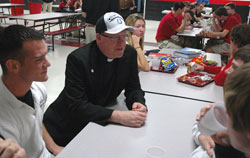 In case you haven't already, do go check out reporter Sean Gallagher's excellent story about the Colt's chaplain: Father Peter Gallagher, one of our archdiocesan priests.
Excerpt:
The Indianapolis Colts had just completed a 38-34 heart-pounding victory on Jan. 21 that would send them to the Super Bowl on Feb. 4 in Miami.
With blue and white confetti streaming through the air, team owner Jim Irsay and head coach Tony Dungy stood on a stage on the field at the RCA Dome in Indianapolis to receive the Lamar Hunt Trophy, which is awarded each year to the winner of the American Football Conference Championship.
At that moment—arguably the greatest in the history of the Colts’ franchise since its move to Indianapolis in 1984—both men expressed thanks and praise to God.
Standing nearby, Father Peter Gallagher, the Colts’ chaplain, appreciated their words.
“I was grateful that [Irsay] said that and I thought, ‘Man, thank you,’ ” said Father Gallagher.
All of us here at The Criterion wish Father Peter the best as he travels to Miami this week -- and more importantly, we wish the best (and victory) for our Indianapolis Colts.
Go blue!
Thursday, January 11, 2007
I'll have a slice of piety, please
You can get the CNS news brief of this story on the CNS Web site, or the for the next 30 days you can view the full version on our Criterion site:
English cardinal calls for revival of traditional practices of piety
An excerpt:
It is indeed sad to see these things practiced so little -- either because of our busyness or skepticism of the good they do. Good job, Cardinal Murphy-O'Connor!
English cardinal calls for revival of traditional practices of piety
An excerpt:
Cardinal Murphy-O'Connor said he lamented the decrease in acts of piety such as fasting, abstinence, Stations of the Cross, praying the rosary and adoration of the Blessed Sacrament because they are a "good means of deepening our faith."
The cardinal said the acts, as well as confession, which is also in decline, were "truly part of Catholic tradition and devotion and are a nourishment to our faith, and I would encourage them," he said in a letter read at Masses Jan. 7 in the Archdiocese of Westminster.
He said there are many other ways in which Catholics "can develop those practices which are truly rooted in Catholic tradition" and bring them closer to Jesus.
"How many people pray before meals or, indeed, after them, recognizing that all we have is a gift from God?" he asked. "How many parents pray, not only for your children, but with your children as they grow up?
It is indeed sad to see these things practiced so little -- either because of our busyness or skepticism of the good they do. Good job, Cardinal Murphy-O'Connor!
Tuesday, December 19, 2006
Equal, not identical
A Catholic News Service piece from Dec. 18 records some of the discussion at a Dec. 15 Rome conference on "Feminism and the Catholic Church."
The event included comments from Mary Ann Glendon, a Harvard law professor and the president of the Pontifical Academy of Social Sciences -- not a bad résumé. Overall, a good and needed reflection on the continuing need of reformation on the part of the institutional Church.
Excerpts:
For the next 30 days, get the whole story on our Criterion Web site.
The event included comments from Mary Ann Glendon, a Harvard law professor and the president of the Pontifical Academy of Social Sciences -- not a bad résumé. Overall, a good and needed reflection on the continuing need of reformation on the part of the institutional Church.
Excerpts:
Unless the Catholic Church can show the world concrete models of male-female cooperation in positions of responsibility and decision-making, the church will continue to struggle against charges that it is chauvinistic, said Mary Ann Glendon.
The Harvard law professor and president of the Pontifical Academy of Social Sciences said church teaching that women and men are equal, but not identical, is a healthy corrective to the feminism of the late 20th century, which, she said, promoted a "unisex society."
- - - - - - -
She said changes in the right direction can be seen in parishes and dioceses where "more and more priests, inspired by recent popes and comfortable with women" are relying on their talents and working with them for the benefit of the community.
She and [Lucetta] Scaraffia [a professor at Rome's La Sapienza University] argued that in any social institution directives from the top are essential, but lasting change flows from the grass roots up.
"The problem with the church today is the lack of women in positions of responsibility at the Vatican," Scaraffia said. "This must change and I believe it will," she added, saying her argument "has nothing to do with the question of women priests."
For the next 30 days, get the whole story on our Criterion Web site.
Thursday, December 14, 2006
No bias here at all
When I saw this story today I couldn't help but post it to give props to my old Newman Center:
Newman Center at University of Illinois to expand
Here is an excerpt:
Newman Center at University of Illinois to expand
Here is an excerpt:
The new facility will address both an increasing demand for housing at Newman Hall -- a 300-bed residence hall built in 1929 that has a waiting list of nearly 200 -- and a lack of program space for outreach to the nearly 12,000 Catholic students at the University of Illinois.
- - - - - - -
At a Nov. 21 press conference announcing the planned expansion, Bishop Jenky called St. John's "the premier Newman Center in America." It is staffed by six full-time priests and three women religious, and has a full-time lay staff of 55. In addition to the residence hall, it includes St. John's Catholic Chapel as well as the Institute of Catholic Thought.
"This project has statewide impact and a national scope because of the demographics of students at the University of Illinois," said Bishop Jenky, which he called "one of the world's best-known secular universities."
The 127,000-square-foot brick structure will have two wings, one six stories tall and the other three stories tall. Resident rooms will be a combination of suites, double bedrooms and single rooms configured in the latest style of college residential living, including private baths and commons areas.
The facility also will include a 300-seat cafeteria, a Newman Club, where nonresidents as well as residents can gather for study and relaxation, a fitness center, and various meeting rooms.
Monday, November 13, 2006
It's the end of the world as we know it
Not really, but this article from Catholic News Service provides a little bit of correction to those people that are always preaching the latest earth-death scenario: In scientific predictions, the only certainty is nothing is certain
Sometimes the great fun of science is knowing how small we are as human beings and how much bumbling around it takes to get to good, solid information. Think of the roller coaster ride that science has taken through the ages, all the theories that at one time were accepted by the world's scientists that ended up being at best in need of modification and at worst flat wrong. Usually they were the product of decent reasoning with a limited amount of knowledge or data. It makes religious look pretty even keel and sensible by comparison!
But, as the wise philosopher knows, its a good thing to know how little you know. We don't know the answers to many of life's scientific questions, and what we do know is subject to future revision. Still, the apple is tempting, and all too many politicians or scientists or other folks want to make absolute surety where there is none. From the article:
I've always sort of wondered why environmentalists in particular seem tempted to this sin against science. In the past few decades we've see the infamous failures of the theories of global cooling or catastrophic overpopulation (and we've also seen the ill effects of pollution and reckless consumerism), both accepted by many of the world's scientists. And now it is global warming, and the suspicious claim that not only can we tell the world's future with certainly, but that we can narrow it down to precise years.
The scientists in the story talk about the conflict between making bad predictions and living with not making predictions at all. As for me, I don't know why it isn't enough to say, for instance, "the earth is warming, and there is a decent chance that we have something to do with it and that it's going to cause us some harm. We ought to begin to practice good stewardship and care for the earth the way God intended." It's always that there has to be a disaster looming, and not just any disaster, but the possible destruction of all human life...and soon!!! Maybe its our sinfulness or (particularly Western) sloth that causes the movers and shakers and thinkers to keep insisting that the next disaster is around the corner. That kind of thinking -- and those kind of stakes -- make for bad predictions.
That's why I generally avoid those charged conversations with others about how we suddenly know all there is to know about the gay gene or global warming or why (INSERT FOOD HERE) is bad/good or the surety of embryonic stem cell research. My favorite is astronomy. It's got all the grand theories and predictions -- and yes, the changes and discoveries of bad theory -- on a time scale that prevents apocalypse now and on a level that keeps the politicians and lobbyists uninterested.
So go read the story -- it's a good balancing factor for us living at the end of the world as we know it.
Sometimes the great fun of science is knowing how small we are as human beings and how much bumbling around it takes to get to good, solid information. Think of the roller coaster ride that science has taken through the ages, all the theories that at one time were accepted by the world's scientists that ended up being at best in need of modification and at worst flat wrong. Usually they were the product of decent reasoning with a limited amount of knowledge or data. It makes religious look pretty even keel and sensible by comparison!
But, as the wise philosopher knows, its a good thing to know how little you know. We don't know the answers to many of life's scientific questions, and what we do know is subject to future revision. Still, the apple is tempting, and all too many politicians or scientists or other folks want to make absolute surety where there is none. From the article:
In an effort to remind science of the impact its predictions have on the public, the Vatican hosted a meeting on the limits and accuracy of predictability in science.
Dozens of scientists and several theologians from all over the world gathered for the Pontifical Academy of Sciences Nov. 3-6 plenary assembly to discuss how far the eye of science can see into the future and when calculations might be considered certain, probable or highly unlikely.
On the one hand, most scientists want to give as much early warning as possible about impending dangers such as earthquakes or climate changes.
On the other hand, they know the earlier the forecast, the more likely the prediction can be wrong, and being wrong makes scientists run the risk of losing the public's trust.
I've always sort of wondered why environmentalists in particular seem tempted to this sin against science. In the past few decades we've see the infamous failures of the theories of global cooling or catastrophic overpopulation (and we've also seen the ill effects of pollution and reckless consumerism), both accepted by many of the world's scientists. And now it is global warming, and the suspicious claim that not only can we tell the world's future with certainly, but that we can narrow it down to precise years.
The scientists in the story talk about the conflict between making bad predictions and living with not making predictions at all. As for me, I don't know why it isn't enough to say, for instance, "the earth is warming, and there is a decent chance that we have something to do with it and that it's going to cause us some harm. We ought to begin to practice good stewardship and care for the earth the way God intended." It's always that there has to be a disaster looming, and not just any disaster, but the possible destruction of all human life...and soon!!! Maybe its our sinfulness or (particularly Western) sloth that causes the movers and shakers and thinkers to keep insisting that the next disaster is around the corner. That kind of thinking -- and those kind of stakes -- make for bad predictions.
That's why I generally avoid those charged conversations with others about how we suddenly know all there is to know about the gay gene or global warming or why (INSERT FOOD HERE) is bad/good or the surety of embryonic stem cell research. My favorite is astronomy. It's got all the grand theories and predictions -- and yes, the changes and discoveries of bad theory -- on a time scale that prevents apocalypse now and on a level that keeps the politicians and lobbyists uninterested.
So go read the story -- it's a good balancing factor for us living at the end of the world as we know it.
Reflections from a young Catholic
Hands down, my favorite religious periodical out there is First Things, which bills itself as a "journal of religion, culture and public life." It's good stuff, and every issue is packed with much "meatier" articles than you'll find in a lot of other Catholic magazines.
This past October's issue featured a very long article by Joseph Bottum titled "When the Swallows Come Back to Capistrano: Catholic Culture in America." The gist of the article is a trace in the decline of a Catholic culture in America and the rise of post-Vatican II in-fighting between often self-described liberals and conservatives.
His contention is that, through mysterious ways, a new Catholic culture is beginning to come together, like loose stars forming a galaxy -- and part of the core and start of that galaxy is opposition to the 1973 Supreme Court ruling on abortion. "The result," Bottum claims, "is the beginning of a new culture: a new Catholicism that, at its best, simply bypasses the stalemates of the 1970s."
While perhaps a simplistic theory, it's got many good points and insights. The whole article is well-worth reading and pondering, and is available free online. Of particular note to me, as a young Catholic, was what he said about us. He argues that there is a growing disconnect with young Catholics from older Catholics and leaders -- even bishops.
I quote quite liberally because he says it better than I could:
I find myself all too often getting pulled into these battles, taking various side, letting myself get angry and worked up...I find myself stepping back -- or yanking myself back -- into remembering my "JPII heritage." Ultimately Bottum's point about the pro-life movement gathering together a new Catholic culture that is ready to change our culture is tied up with the efforts of Pope John Paul the Great to preach an authentic vision of the Second Vatican Council and of the nature of man.
For me as a young Catholic, and for the many, many other young Catholics I know, this is what it's about: seeking through Jesus Christ the wisdom that answers the two great questions we have, that is, Who is God, and What is man? College students embark on their journey with these questions and there is a certain sickness that I feel when I think of how many get the wrong answers -- even by Catholic priests and teachers of the faith.
Pope John Paul was, for so many of us, the living icon of this answer. He was the genuine leader in whose shadow you could trace the life and teachings of the One he followed. More and more Catholic young people are growing up with the benefit of his scholarship: we are people whose whole lives have been informed by a rich, Catholic view of who we are and how we are to live. For us, the Church's answers to the hot-button questions of contraception, homosexuality, abortion, ESC research, the death penalty and female ordination are beautiful -- and more than that, they are true. To say that the teachings on those subjects in particular are true and beautiful is more than a little scandalous to many older Catholics I know -- almost as though I've crossed some invisible line that has actually called my Christianity into question.
One of the hallmarks, in my opinion, of this new, growing breed of young Catholics is not so much the rejection of the warring camps that Bottum suggests, but the simple joy with which they embrace Jesus Christ and his Church, the happiness with which they live the tenets of our faith. Those same warring camps are always trying to drag us into their battles -- trying to make us fight on their terms and fit their stereotypes and have their motivations.
But another hallmark is what Bottum mentions and what many of the saints had: the "get out of my way" attitude toward silliness and stalemate rivalries that is what Christ demands. The world is in danger, as it always is: the devil and sin stand to devour the souls of our brothers and sisters, and we must stand in their way -- we must sacrifice and battle and answer the heavenly call to action. There is no time for us to fight a battle that isn't ours and that distracts us needlessly from the task.
In the end, we're trying to be saints and to follow Jesus Christ and prophetic voices like that of Pope John Paul the Great -- we shouldn't care about all the hip buzz terms in lay ministry or whether we're for a "cultic" priesthood or if we like to be under the thumb of Rome or if we lack a pluralistic mindset or why we're too divisive or any of the other endless arguments...we're trying to live for Christ and to love what Christ loves, even those parts that make our culture hiss. And power politics and Church theories and doctrinal fighting cannot stop that.
This past October's issue featured a very long article by Joseph Bottum titled "When the Swallows Come Back to Capistrano: Catholic Culture in America." The gist of the article is a trace in the decline of a Catholic culture in America and the rise of post-Vatican II in-fighting between often self-described liberals and conservatives.
His contention is that, through mysterious ways, a new Catholic culture is beginning to come together, like loose stars forming a galaxy -- and part of the core and start of that galaxy is opposition to the 1973 Supreme Court ruling on abortion. "The result," Bottum claims, "is the beginning of a new culture: a new Catholicism that, at its best, simply bypasses the stalemates of the 1970s."
While perhaps a simplistic theory, it's got many good points and insights. The whole article is well-worth reading and pondering, and is available free online. Of particular note to me, as a young Catholic, was what he said about us. He argues that there is a growing disconnect with young Catholics from older Catholics and leaders -- even bishops.
I quote quite liberally because he says it better than I could:
These were serious Catholic kids—daily communicants, pro-life marchers, soup-kitchen volunteers, members of perpetual-adoration societies. They were showing off a little for their guest, no doubt: taking stronger positions than they actually feel, arguing for the joy of arguing, the way college students do. It was revealing, however, that when one of them shyly mentioned the Tridentine Mass at the renegade chapel in Garden Grove, the others shouted her down.
Sure, they agreed, pretty Masses are better than ugly ones, and they all preferred high-churchy smells and bells to guitar services and liturgical dance: the things their parents’ generation, poor souls, fondly imagined would “engage today’s youth.” But the radical traditionalists seemed cut from the same cloth as the radical revisionists—and the students dismissed all that kind of 1970s stuff as simultaneously boring and infuriating: the self-obsession and self-glorification of the two sides that, between them, had wrecked Catholic culture in this country. We live with a million aborted babies a year, daily scandals of corruption in the Church, millions of uncatechized Catholic children, and this is what those tired old biddies are still squabbling over?
“You remember how, you know, the old hippie types used to say, ‘Never trust anyone over thirty’? Well, they were right. Only it was their own generation they were talking about,” the thin, quiet one in the back announced as we pulled up to the hotel. “You can see it clearly out here in California. That whole generation of Catholics in America, basically everybody formed before 1978, is screwed up. Left, Right, whatever....The best of them were failures, and the worst of them were monsters.”
- - - - - - -
This quick, irritated impatience seems common in the emerging Catholic culture. You find it in the parishioners of the Polish Dominicans working at Columbia University, and in the conservatives gathered around the political theorist Robert George at Princeton. For that matter, it is present among the graduate students at such places as Notre Dame and Boston College, and among the younger theology professors around the country. The public figures of the new culture—the Catholic lawyers, magazine writers, and think-tank analysts—have it in spades: an intolerance, an exasperation, with everything that preoccupied an entire generation of American Catholics.
- - - - - - -
Still, in at least one sense, these Catholics seem right to reject the battles of the recent past. The greatest work of John Paul II may prove his reintegration of Vatican II into the history of the Catholic Church: a swerve, a changing of the trajectory that both sides in the 1970s had assumed could not be altered. Far too many in those days believed the Second Vatican Council had definitively broken the Catholic Church from its past. Whether they wept or cheered, whether they were traditionalists or spirit-of-Vatican-II reformers, they acted as though the new Church were no longer in continuity with the old Church.
I find myself all too often getting pulled into these battles, taking various side, letting myself get angry and worked up...I find myself stepping back -- or yanking myself back -- into remembering my "JPII heritage." Ultimately Bottum's point about the pro-life movement gathering together a new Catholic culture that is ready to change our culture is tied up with the efforts of Pope John Paul the Great to preach an authentic vision of the Second Vatican Council and of the nature of man.
For me as a young Catholic, and for the many, many other young Catholics I know, this is what it's about: seeking through Jesus Christ the wisdom that answers the two great questions we have, that is, Who is God, and What is man? College students embark on their journey with these questions and there is a certain sickness that I feel when I think of how many get the wrong answers -- even by Catholic priests and teachers of the faith.
Pope John Paul was, for so many of us, the living icon of this answer. He was the genuine leader in whose shadow you could trace the life and teachings of the One he followed. More and more Catholic young people are growing up with the benefit of his scholarship: we are people whose whole lives have been informed by a rich, Catholic view of who we are and how we are to live. For us, the Church's answers to the hot-button questions of contraception, homosexuality, abortion, ESC research, the death penalty and female ordination are beautiful -- and more than that, they are true. To say that the teachings on those subjects in particular are true and beautiful is more than a little scandalous to many older Catholics I know -- almost as though I've crossed some invisible line that has actually called my Christianity into question.
One of the hallmarks, in my opinion, of this new, growing breed of young Catholics is not so much the rejection of the warring camps that Bottum suggests, but the simple joy with which they embrace Jesus Christ and his Church, the happiness with which they live the tenets of our faith. Those same warring camps are always trying to drag us into their battles -- trying to make us fight on their terms and fit their stereotypes and have their motivations.
But another hallmark is what Bottum mentions and what many of the saints had: the "get out of my way" attitude toward silliness and stalemate rivalries that is what Christ demands. The world is in danger, as it always is: the devil and sin stand to devour the souls of our brothers and sisters, and we must stand in their way -- we must sacrifice and battle and answer the heavenly call to action. There is no time for us to fight a battle that isn't ours and that distracts us needlessly from the task.
In the end, we're trying to be saints and to follow Jesus Christ and prophetic voices like that of Pope John Paul the Great -- we shouldn't care about all the hip buzz terms in lay ministry or whether we're for a "cultic" priesthood or if we like to be under the thumb of Rome or if we lack a pluralistic mindset or why we're too divisive or any of the other endless arguments...we're trying to live for Christ and to love what Christ loves, even those parts that make our culture hiss. And power politics and Church theories and doctrinal fighting cannot stop that.
Monday, November 06, 2006
Religion and science, etc., etc., etc.
Whenever I hear of religion and science I tend to think more in terms of faith and reason, and the miraculous balance that the Catholic Church has achieved between them. It seems like media types aren't the only ones endlessly interested in prolonging a dead war between two allies...it's hard to pick who to shake your head at more: those philosophers and thinkers who, generation after generation, insist that we are in the last days of religion, or the Christians who insist that the only reasonable way to read Scripture is an utterly reasonless literal interpretation.
I was treated this morning to a few minutes of local talk radio with call ins debating how Adam and Eve's sons had children and how the story of the Tower of Babel accounts for the different races of the world. Adam and Eve, the fall of man, the drama of salvation -- these are the great themes that interest me to no end...unless the conversation falls into either an obsession with whether our first parents had belly buttons or how the mere thought of anything outside of Darwinian evolution is a threat to democracy.
Time magazine apparently has a story about the debate, titled provcoatively enough: God vs. science: Can religion stand up to the test? I was not aware that religion had anything to prove, nor that science was in the business of testing God. The link I provided is only to a summary; the real story must be paid for, thus I have not read it, but it seems like the usual back and forth, noting that those on the side of what could be called "evangelical atheism" have come into new prominence:
I would gladly point anyone interested to this most excellent series of articles on the question of Catholicism and evolution (which was, by the way, adapted for publication in Our Sunday Visitor).
But, as always, Pope Benedict cuts through the chatter with a much simpler, more brilliant summation than I could ever offer:
There seems to me something almost intrinsically dehumanizes about using "hard science" alone to determine your world view, or to demand that only those things with absolute empirical evidence be allowed into the public life of humanity. And the defense against such a mindset needs to be more than forcing philosophy into every biology textbook.
There is a living and true God who created the universe -- and to the great majority of men who have ever lived, this is common sense. And that same God endowed us with the marvelous ability to study that wide world and grow in our understanding of how it works. To me, the scientist that uses DNA and brain patterns to "prove" that religious sentiments are no more than impulses is as silly and guilty as the religious who claims that evolution isn't real because you can't see it happening in a lab.
To quote the late, great John Paul II: "Faith and reason are like two wings on which the human spirit rises to the contemplation of truth."
And to quote popular culture: come on, faith and reason, can't we all just get along?
(UPDATE: I saw on Amy Welborn's blog that she has a link to the whole text of Pope Benedict's comments to the Pontifical Academy of Sciences).
I was treated this morning to a few minutes of local talk radio with call ins debating how Adam and Eve's sons had children and how the story of the Tower of Babel accounts for the different races of the world. Adam and Eve, the fall of man, the drama of salvation -- these are the great themes that interest me to no end...unless the conversation falls into either an obsession with whether our first parents had belly buttons or how the mere thought of anything outside of Darwinian evolution is a threat to democracy.
Time magazine apparently has a story about the debate, titled provcoatively enough: God vs. science: Can religion stand up to the test? I was not aware that religion had anything to prove, nor that science was in the business of testing God. The link I provided is only to a summary; the real story must be paid for, thus I have not read it, but it seems like the usual back and forth, noting that those on the side of what could be called "evangelical atheism" have come into new prominence:
It is not an epithet that fits everyone wielding a test tube. But a growing proportion of the profession is experiencing what one major researcher calls "unprecedented outrage" at perceived insults to research and rationality, ranging from the alleged influence of the Christian right on Bush administration science policy, to the fanatic faith of the 9/11 terrorists, to intelligent design's ongoing claims. Some are radicalized enough to publicly pick an ancient scab -- the idea that science and religion, far from being complementary responses to the unknown, are at utter odds.
I would gladly point anyone interested to this most excellent series of articles on the question of Catholicism and evolution (which was, by the way, adapted for publication in Our Sunday Visitor).
But, as always, Pope Benedict cuts through the chatter with a much simpler, more brilliant summation than I could ever offer:
"Christianity does not posit an inevitable conflict between supernatural faith and scientific progress," he stressed, recalling how "God created human beings, endowed them with reason, and set them over all the creatures of the earth." In this way, man became "the steward of creation and God's 'helper.' ... Indeed, we could say that the work of predicting, controlling and governing nature, which science today renders more practicable than in the past, is itself a part of the Creator's plan."
"Man cannot place in science and technology so radical and unconditional a trust as to believe that scientific and technological progress can explain everything and completely fulfil all his existential and spiritual needs. Science cannot replace philosophy and revelation by giving an exhaustive answer to man's most radical questions: questions about the meaning of living and dying, about ultimate values, and about the nature of progress itself."
There seems to me something almost intrinsically dehumanizes about using "hard science" alone to determine your world view, or to demand that only those things with absolute empirical evidence be allowed into the public life of humanity. And the defense against such a mindset needs to be more than forcing philosophy into every biology textbook.
There is a living and true God who created the universe -- and to the great majority of men who have ever lived, this is common sense. And that same God endowed us with the marvelous ability to study that wide world and grow in our understanding of how it works. To me, the scientist that uses DNA and brain patterns to "prove" that religious sentiments are no more than impulses is as silly and guilty as the religious who claims that evolution isn't real because you can't see it happening in a lab.
To quote the late, great John Paul II: "Faith and reason are like two wings on which the human spirit rises to the contemplation of truth."
And to quote popular culture: come on, faith and reason, can't we all just get along?
(UPDATE: I saw on Amy Welborn's blog that she has a link to the whole text of Pope Benedict's comments to the Pontifical Academy of Sciences).
Sunday, November 05, 2006
The devil makes a good argument...
I was on Mark Shea's blog recently and saw a link to this story: "Parish cancels 'Catholic' drag queens' bingo games"
What is most interesting to me is not how the parish of the chancellor of the Archdiocese of San Francisco ended up renting its hall to the notorious "Sisters of Perpetual Indulgence," or how the grassroots strength of Catholics from around the country called and wrote in on this matter until action was taken...no, the most interesting part was contrasting the sordid details of this story with the response from the "Sisters" upon their bingo event lease being cancelled. An excerpt:
Let's imagine that you only heard that a group gay "Catholics" holding a charitable bingo game had been kicked out of a Catholic parish, then read that group's response. It sounds pretty reasonable, pretty squeaky clean, pretty convincing almost...almost...
I find oftentimes that so much of my frustration comes with the oft-repeated human experience that the devil makes a mighty good argument...and distracts people from common sense. The common sense in this particular story comes in realizing who the Sisters of Perpetual Indulgence are, and how they were raising charitable funds. From the story:
So the group basically stands in ridicule and intense mockery of nearly everything that the Catholic Church is, then feigns disapointment that "our shared values cannot overcome our differences of opinion." Well, there are differences of opinion and there are differences of opinion, apparently.
Go read the whole story to see it all
What is most interesting to me is not how the parish of the chancellor of the Archdiocese of San Francisco ended up renting its hall to the notorious "Sisters of Perpetual Indulgence," or how the grassroots strength of Catholics from around the country called and wrote in on this matter until action was taken...no, the most interesting part was contrasting the sordid details of this story with the response from the "Sisters" upon their bingo event lease being cancelled. An excerpt:
The primary mission of The Sisters is involvement in and support of the local community. This includes working with and supporting many local community organizations whose ability to serve their constituency is dependent on contributions from charitable groups like the Sisters. Without the thousands of dollars raised by the consistently sold-out monthly bingo event, their services may be cut at a time when charitable giving is more critical than ever.
The Sisters of Perpetual Indulgence believe that our commitment to giving is in alignment with the philosophy of the Archdiocese of San Francisco, which represents a cross-section of the San Francisco population. It is unfortunate and extremely disappointing that this appears not to be the case, and that our shared values cannot overcome our differences of opinion when it comes to how we serve the community.
Let's imagine that you only heard that a group gay "Catholics" holding a charitable bingo game had been kicked out of a Catholic parish, then read that group's response. It sounds pretty reasonable, pretty squeaky clean, pretty convincing almost...almost...
I find oftentimes that so much of my frustration comes with the oft-repeated human experience that the devil makes a mighty good argument...and distracts people from common sense. The common sense in this particular story comes in realizing who the Sisters of Perpetual Indulgence are, and how they were raising charitable funds. From the story:
The next game, featuring master of ceremonies "Peaches Christ" -- was scheduled for Thursday, All Souls Day, when Catholics typically pray for deceased loved ones.
The Sisters' motto "Go and sin some more" is indicative of their use of mockery to express opposition to Catholic moral norms. They are infamous for their offensive street theater, in which they use Catholic symbols and images to shock opponents and entertain allies. Catholics who walked in the West Coast Walk for Life in 2005 and 2006 report they were heckled and jeered with blasphemous catcalls by the group.
- - - - - - -
A Sept. 14 article by "Sister Dana Van Iquity" in the homosexual newspaper San Francisco Bay Times stated, "The long awaited return of the Castro's longest running Bingo – Revival Bingo —kicked off at Ellard Hall on Sept. 7 at 100 Diamond Street and 18th [the address of Most Holy Redeemer] in the heart of the Castro. The new home includes more space, more seating capacity, a big stage, and a brand new sound & video system (thanks to Dave the bear) with all players on one main floor instead of having to hang from the rafters at the old venue. … A gaggle of nuns -- dozens really -- opened the show, carrying candles and acting rather solemn with slow, marching steps. But when the sound system played 'Gonna Make You Sweat,' the Sisters commenced to clapping and dancing wildly down the aisles, getting everyone's energy up."
The article went on to describe sexual "punishments" meted out to participants whose cell phones ring during the game or who call a false bingo. Prizes distributed to winners, according to the article, range from "wines to porn DVDs to sex toys to toasters and more."
So the group basically stands in ridicule and intense mockery of nearly everything that the Catholic Church is, then feigns disapointment that "our shared values cannot overcome our differences of opinion." Well, there are differences of opinion and there are differences of opinion, apparently.
Go read the whole story to see it all
Tuesday, October 31, 2006
You know it's a slow news day when...
...you see this headline come through the wire at Catholic News Service:
Retired bishop has close encounter with squirrel
There's not much more to this story that what the headline says, but still, it made me laugh to read it...and since not much else of interest was posted by CNS yesterday it made the cut on The Criterion Online Edition.
So go read it and enjoy the small Halloween treat.
Retired bishop has close encounter with squirrel
There's not much more to this story that what the headline says, but still, it made me laugh to read it...and since not much else of interest was posted by CNS yesterday it made the cut on The Criterion Online Edition.
So go read it and enjoy the small Halloween treat.
Friday, October 13, 2006
Mother Theodore canonization coverage
 Don't worry, the staff of The Criterion has not abandoned this blog. The past month and a half has consumed my efforts as I prepared to launch our new Archdiocese of Indianapolis Web site at www.archindy.org (an endeavor that included The Criterion Online Edition).
 The other staff has been working hard to get ready for a coverage blitze of the canonization of Indiana's own Blessed Mother Theodore Guerin on Oct. 15 in St. Peter's Square at the Vatican.
We have a reporter in Rome on an archdiocesan pilgrimage and are sending two to the motherhouse of the Sisters of Providence near Terre Haute -- and all of the coverage is converging on our special event blog devoted to the canonization.
So, while we all hope to soon resume posting on this blog, for now, check out the Guerin blog on our Criterion site for all the latest updates.
Tuesday, August 29, 2006
George Weigel on bad liturgical hymns
We've all probably got our favorite Mass hymns/songs, and the ones that we don't care for so much. George Weigel makes the case that there are some hymns, though, that simply have no place being sung in a Catholic church -- and some based on such silly poetry and phrasing that we should put a moratorium on their use. This was written a couple of years back, but still a fun read:
Go check out the rest of what he has to say here
For classic Lutheran theology, hymns are a theological "source:" not up there with Scripture, of course, but ranking not-so-far below Luther's "Small Catechism." Hymns, in this tradition, are not liturgical filler. Hymns are distinct forms of confessing the Church's faith. Old school Lutherans take their hymns very seriously.
Most Catholics don't. Instead, we settle for hymns musically indistinguishable from "Les Mis" and hymns of saccharine textual sentimentality. Moreover, some hymn texts in today's Catholic "worship resources" are, to put it bluntly, heretical. Yet Catholics once knew how to write great hymns; and there are great hymns to be borrowed, with gratitude, from Anglican, Lutheran, and other Christian sources. There being a finite amount of material that can fit into a hymnal, however, the first thing to do is clean the stables of today's hymnals.
Thus, with tongue only half in cheek, I propose the Index Canticorum Prohibitorum, the "Index of Forbidden Hymns." Herewith, some examples.
Go check out the rest of what he has to say here
Subscribe to:
Posts (Atom)
